qp.transforms.reduce_t_depth
- reduce_t_depth(qnode)
A quantum compilation pass that reduces the depth and count of non-Clifford Pauli product rotation (PPR, \(P(\theta) = \exp(-iP\theta)\)) operators (e.g.,
Tgates) by commuting PPRs in adjacent layers and merging compatible ones (a layer comprises PPRs that mutually commute). For more details, see Figure 6 of A Game of Surface Codes.Note
This transform requires decorating the workflow with
@qp.qjit. In addition, the circuits generated by this pass are currently executable onlightning.qubitornull.qubit(for mock-execution).Lastly, the
pennylane.transforms.to_ppr()transform must be applied beforereduce_t_depth.See also
pennylane.transforms.to_ppr(),pennylane.transforms.commute_ppr(),pennylane.transforms.merge_ppr_ppm(),pennylane.transforms.ppr_to_ppm(),pennylane.transforms.ppm_compilation(),pennylane.transforms.decompose_arbitrary_ppr()Note
For better compatibility with other PennyLane functionality, ensure that PennyLane program capture is enabled with
@qjit(capture=True).Example
In the example below, after performing the
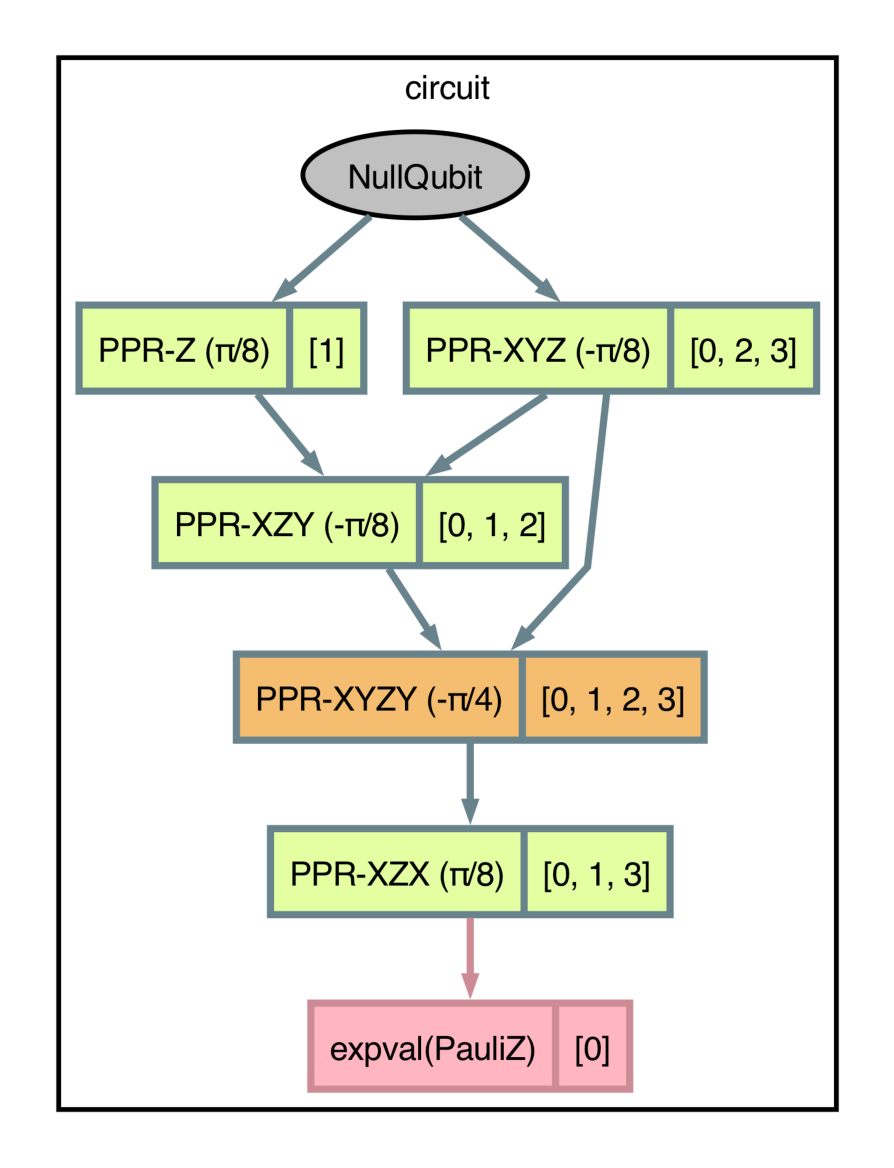
pennylane.transforms.to_ppr()andpennylane.transforms.merge_ppr_ppm()passes, the circuit contains a depth of four of non-Clifford PPRs. Subsequently applying thereduce_t_depthpass will move PPRs around via commutation, resulting in a circuit with a smaller PPR depth.Specifically, in the circuit below, the Pauli-\(X\) PPR (\(\exp(iX\tfrac{\pi}{8})\)) on qubit Q1 will be moved to the first layer, which results in a depth of three non-Clifford PPRs.
Consider the following example:
import pennylane as qp
import jax.numpy as jnp

@qp.qjit(capture=True)
@qp.transforms.reduce_t_depth
@qp.transforms.to_ppr
@qp.qnode(qp.device("null.qubit", wires=4))
def circuit():
    qp.PauliRot(jnp.pi / 4, pauli_word="Z", wires=1)
    qp.PauliRot(-jnp.pi / 4, pauli_word="XYZ", wires=[0, 2, 3])
    qp.PauliRot(-jnp.pi / 2, pauli_word="XYZY", wires=[0, 1, 2, 3])
    qp.PauliRot(jnp.pi / 4, pauli_word="XZX", wires=[0, 1, 3])
    qp.PauliRot(-jnp.pi / 4, pauli_word="XZY", wires=[0, 1, 2])

    return qp.expval(qp.Z(0))
The
reduce_t_depthcompilation pass will rearrange the last three PPRs in the above circuit to reduce the non-Clifford PPR depth. This is best seen with thecatalyst.draw_graph()function:>>> import catalyst >>> num_passes = 2 >>> fig1, _ = catalyst.draw_graph(circuit, level=num_passes-1)() >>> fig2, _ = catalyst.draw_graph(circuit, level=num_passes)()
Without
reduce_t_depthapplied:>>> fig1.savefig('path_to_file1.png', dpi=300, bbox_inches="tight")
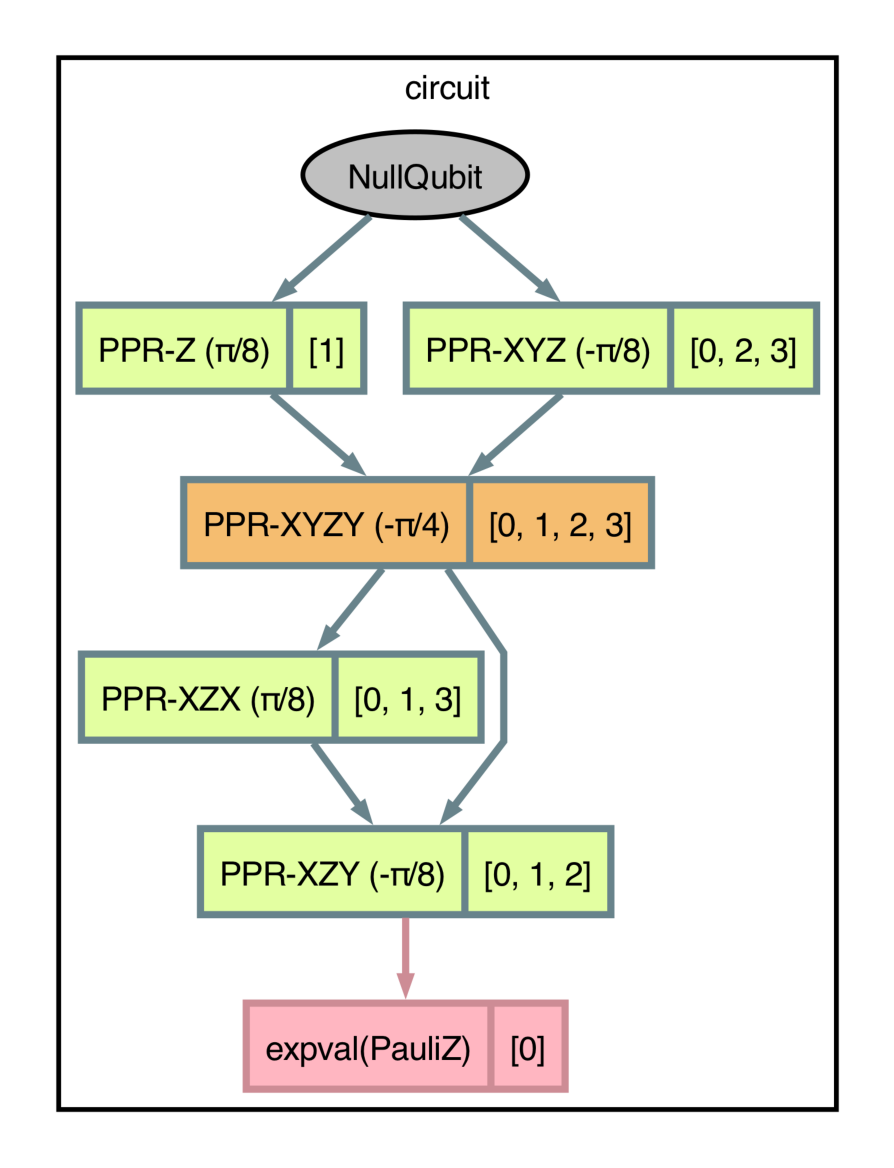
With
reduce_t_depthapplied:>>> fig2.savefig('path_to_file2.png', dpi=300, bbox_inches="tight")